




New Hope Creek Restoration: A Community Effort
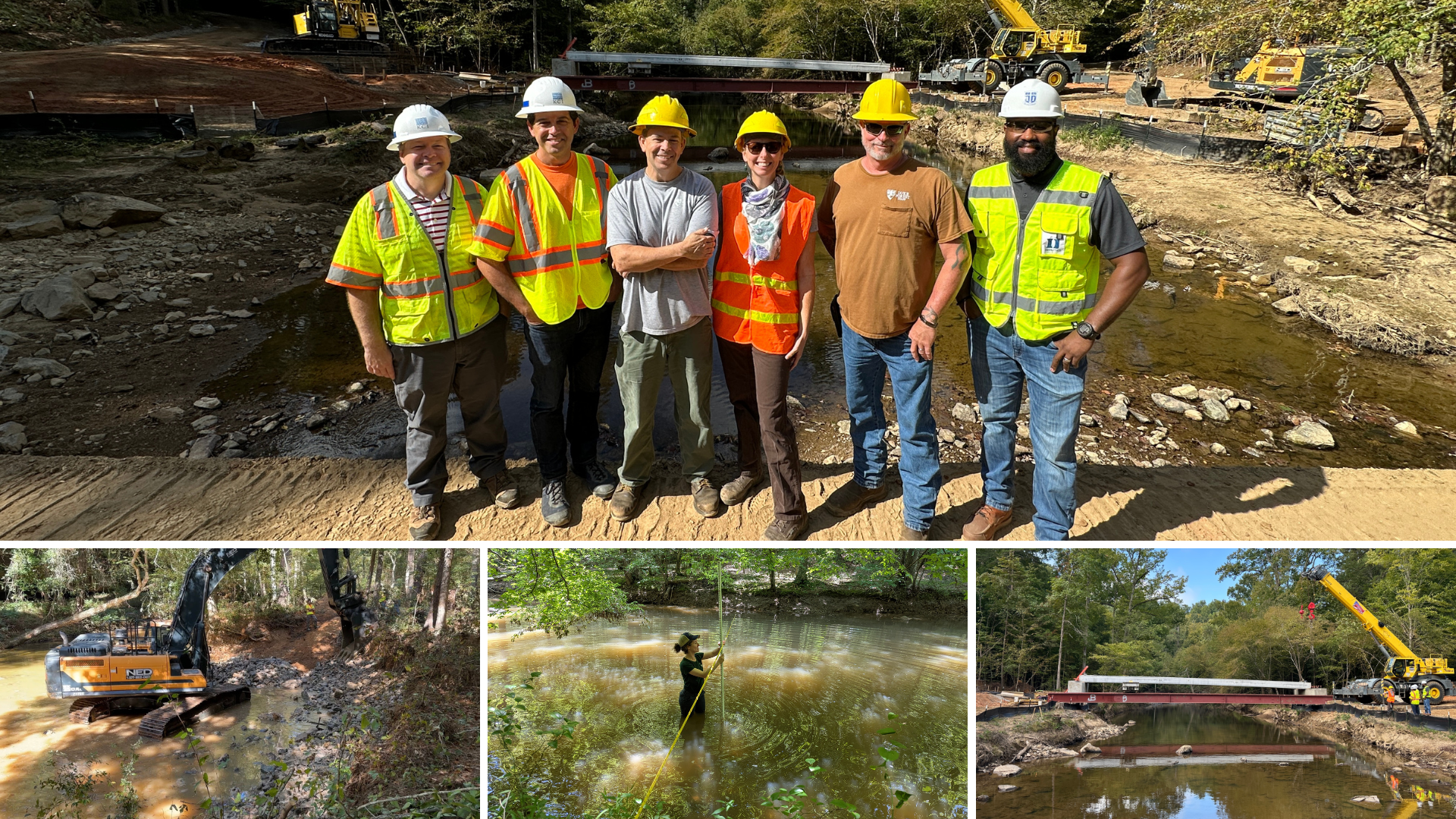
New Hope Creek is the lifeblood of the Duke Forest’s Korstian Division and a vital tributary to Jordan Lake, a drinking water source for our region. Currently, the creek is the focus of a three-phase restoration effort that is as much about people and partnerships as it is about water and ecosystems. This undertaking is deeply collaborative, uniting staff, students, researchers, practitioners, experts, and community members in a shared responsibility to promote a healthy, resilient stream ecosystem.
The path to restoring New Hope Creek began in 2011, when Nicholas School’s Lynnette Batt MEM ‘08 first proposed removing the two aquatic barriers to fellow alum Sara Childs MEM ’08, who had recently joined the Duke Forest team. Though the idea was compelling, its complexity and cost stymied progress until 2021, when two eager and capable MEM students—Andrew Friedman-Herring MEM ’23 and Jackie van der Hout MEM ’23—offered to support Sara’s efforts to prepare for a feasibility study. In 2022, the Duke Forest contracted with KCI Associates of North Carolina and their project team led by Adam Spiller MEM ’05 to conduct this analysis.
As funding came together in 2023, momentum grew. In partnership with Triangle Land Conservancy, the Duke Forest secured a grant from the North Carolina Land and Water Fund. Leadership gifts from Brad and Shelli Stanback, Alston Gardner, and Adam and Rosalind Abram then closed the financial gap and allowed this historic effort to launch.
As the project moved to implementation, the network of collaborators expanded. Duke Facilities Management staff—Gregory Stribling and Michael Daush—took a lead role in shepherding project administration while additional engineers, ecologists, researchers, and students joined forces to prepare on the ground. Before construction began, North Carolina Wildlife Resources Commission biologists led efforts to relocate freshwater mussels away from the project area. Duke drone experts with the Marine Robotics and Remote Sensing Lab, including Libby White MEM ’24, flew pre-construction flights to collect high-resolution photography and LiDAR data to underpin future project assessments. The Duke Forest team, in partnership with a trusted local logger, readied the construction site and forest roads, completing this work with minimal tree removal.
After more than a decade of conversations and collaborations, the results of these efforts are now visible. Sanford Contractors began constructing the new clear-span bridge over New Hope Creek in July, and it is nearly complete. Downstream, the Billy Erwin Dam has been removed, and its stone has been redistributed to stabilize the eroded banks nearby. When all three phases are complete—following the demolition and removal of the old low-water bridge—New Hope Creek will flow freely through the Duke Forest for the first time in more than a century.
These restoration efforts are a testament to the power of people working in collaboration and exemplify what a community of people with a shared commitment can accomplish. Restoring New Hope Creek strengthens the Duke Forest, local community, and health of our ecosystems, helping to ensure that all continue to thrive.
More information and project updates are available at dukeforest.duke.edu/CreekRestoration.
Forest Greeting: From the Director’s Desk
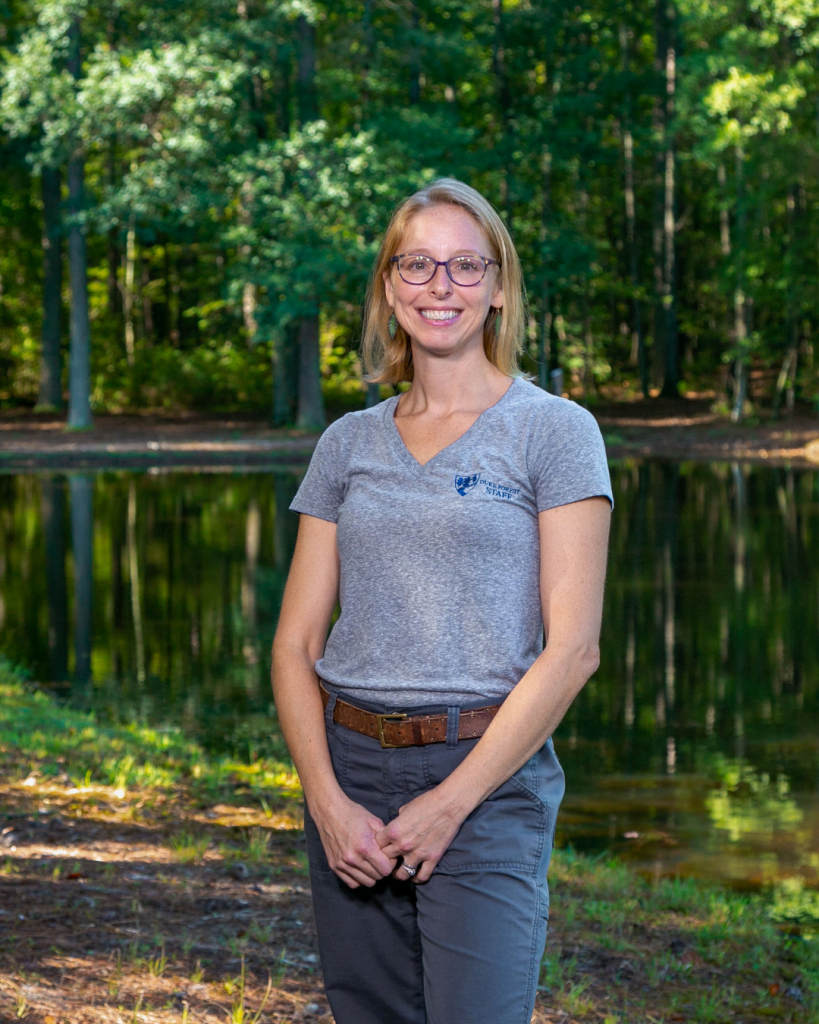
Since the pandemic began over five years ago, I have felt compelled to begin this message by acknowledging our shared hardships. And while a small part of me wants to take refuge inside of wishful thinking, this year is no different.
With the tremendous changes and uncertainties shaping our world today, the typical rhythms of Duke University have been shifted. Though there remains light, opportunity, ambition, and a steadfast commitment to Duke’s priorities, for some colleagues across Duke, their lives and plans abruptly changed—sometimes for the better, sometimes not—as voluntary separations and reductions in force became necessary to address unexpected financial impacts.
I am deeply grateful to all of my Duke colleagues—past and present—that have contributed their time and energy to the collaborative effort that is Duke University. In many ways, the extraordinary work highlighted in this edition of The LOG stands as a testament to all of us.
The New Hope Creek Restoration Projects featured on the front page demonstrate the immense people-power necessary to pull off such complex, technical, and expensive efforts. From the beginning, these projects have been influenced by the passion and drive of Nicholas School of the Environment students. Bringing them to fruition has required intentional cultivation of relationships and partnerships with: local and national nonprofits; state and federal agencies; private engineering and contracting firms; individuals who direct their resources to positive outcomes on-the-ground; and of course, a multitude of Duke staff, faculty, and administrators that in various ways facilitated this work. The lasting effects of these projects on the health, vitality, and resilience of New Hope Creek is a legacy all of us now share.
As is often true in challenging times, it is the determination, dedication, and passion of individuals and groups who show up and do good work for something larger than themselves—for a forest that sustains so many life-giving resources or for the community that fosters its stewardship—that remains our light. I hope that as you read this edition of The LOG, the people-power behind these stories shines, offering you a glimmer or perhaps even a ray of hope.
Celebrating the Forest’s People Power
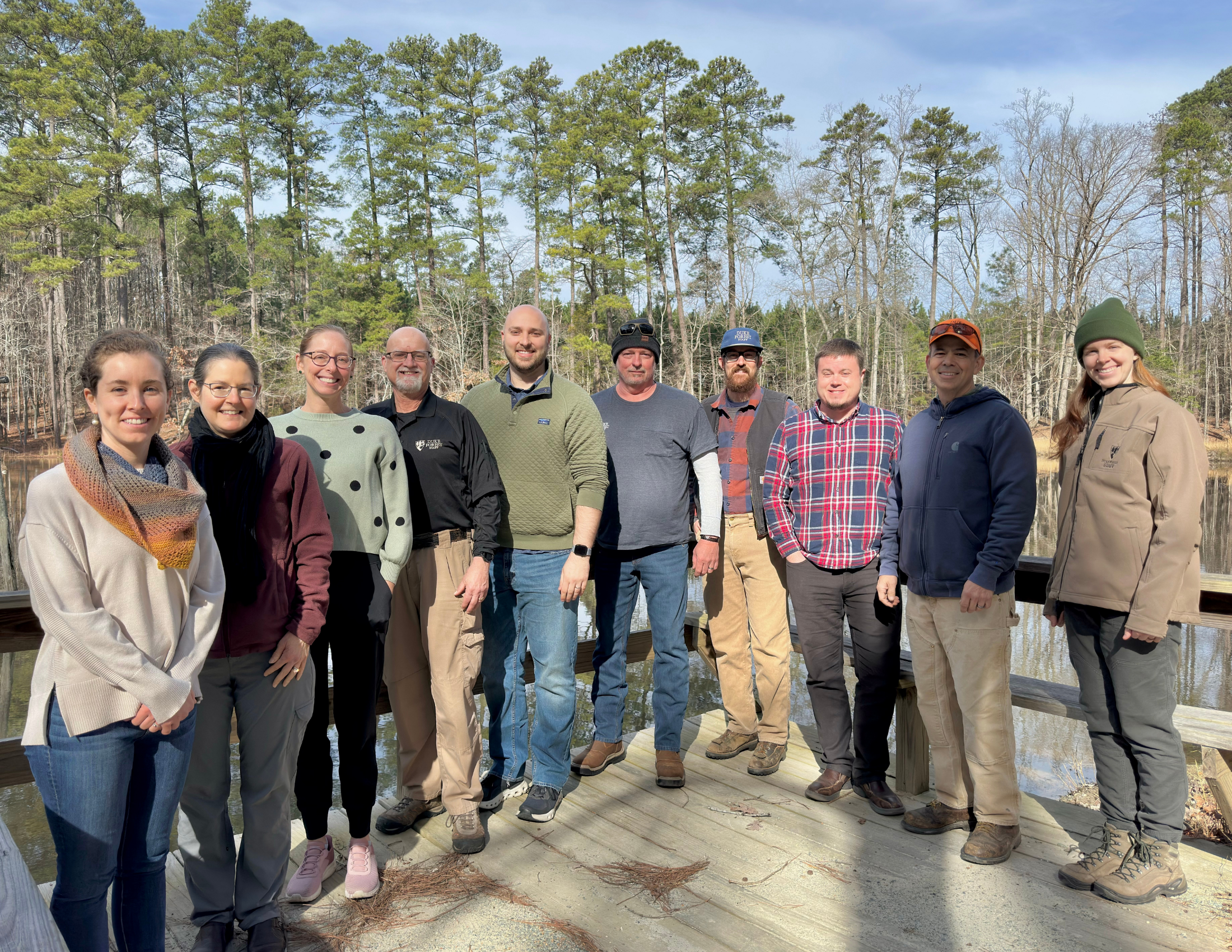
The team of professionals that make up the Office of the Duke Forest and are responsible for the mission and stewardship of the Duke Forest Teaching and Research Laboratory are arguably its greatest asset. Each person plays a unique role in implementing activities across the operational, programmatic, and financial work that sustains the Duke Forest. Even more importantly, each team member respects and prioritizes the responsibility to support one another.
For their tireless efforts this summer, our field-based team—Tom Craven, Zach Carnegie, and Craig Hughes—deserve special recognition. They worked through the sweltering heat to carefully prepare the roads and clear the restoration site for bridge construction. When Tropical Storm Chantal brought flooding along New Hope Creek not seen since Hurricane Fran, they quickly pivoted to resolving the most pressing issues. With grit, determination, a little humor, and some heavy equipment, they repaired roads, removed hazard trees, and ensured minimal disruption to the construction timeline.
This summer also brought some changes across our team. We said goodbye to Kevin Egan, our first Forest Protection and Safety Coordinator, whose role concluded as part of Duke’s strategic realignment and cost reduction efforts (context on page 2). Kevin played an important role in helping to ensure a productive environment for the diverse community of Forest users, and we are grateful for the expertise he brought to the team.
In August, we celebrated Maggie Heraty as she began her Master of Natural Resources at NC State. Maggie has been instrumental in advancing community engagement with science and stewardship at the Duke Forest. As an intern in 2016, she co-created and launched the Shepherd Nature Trail. Later, as full-time staff, she developed our first-ever Forest Stewards Program and oversaw the growth of the Herpetofauna Program, among other successes. Most recently, in her part-time role, she led the creation of the Unearthing Duke Forest signs set to debut in Spring 2026.
Beyond this impressive body of work, Maggie’s impact lies in the authentic, kind, and inclusive manner she brought to all her interactions with our team and community. We will miss her as she steps away at the end of the year, but we are excited to watch her journey unfold.
Partnering for Biodiversity Across the Region
As the university’s largest land-based unit, the Duke Forest plays a vital role in biodiversity research, management, and outreach. We aim to better understand, protect, and celebrate biodiversity as an essential component of a climate-resilient world. But we can’t do it alone!
Our engagement and leadership in the Triangle Connectivity Collaborative (TCC) remain strong through Executive Director Sara Childs’ continued service on its steering committee and conservation working group. This regional initiative, which promotes biodiversity conservation through a landscape-scale approach, is making steady progress on its Strategic Action Plan. The TCC works proactively across land-use, transportation, and conservation to maintain and restore habitat connectivity and protect vital wildlife corridors across the Neuse and Cape Fear watersheds. Learn more at connectedconservationnc.org.
Another exciting partnership is the Carolina Biodiversity Collaborative (CBC), founded by biology faculty at UNC-Chapel Hill. It includes partnerships with NC State University and its Insect Museum, the UNC Botanical Garden and Herbarium, and the NC Museum of Natural Sciences. The Duke Forest recently joined the CBC, strengthening a shared commitment to promote teaching and research that advances knowledge and action for the protection of biodiversity.
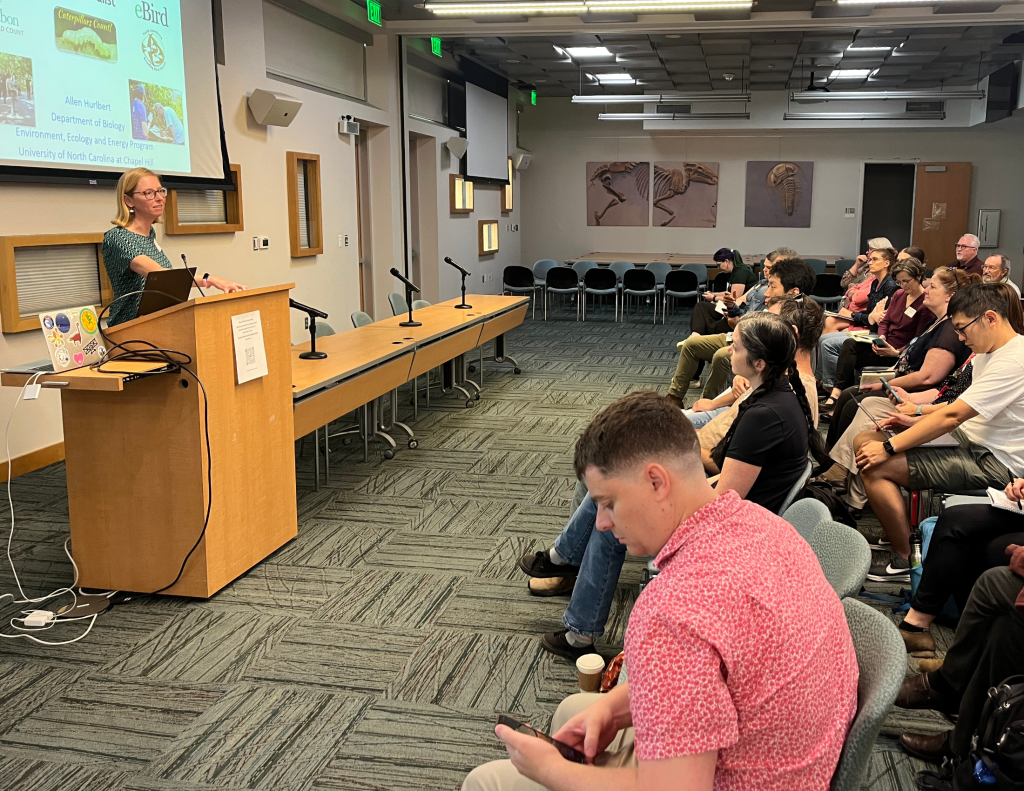
This year, Sara Childs delivered a keynote address at the CBC’s Annual Symposium, describing the numerous biodiversity initiatives of the Duke Forest, including our community science herpetofauna monitoring, graduate student research on wildlife using camera traps and acoustic monitoring, and ongoing external partnerships. Learn more at cbc.unc.edu.
Our Duke Forest team doesn’t just talk the talk; we walk the walk! In October, we hosted Biodiversity Day, an educational community event featuring guided hikes, demonstrations, and hands-on explorations led by local experts. Event attendees learned about the mussels, birds, fungi, and plant communities that call the Forest home. It was a joyful celebration and a powerful reminder of why protecting our local flora and fauna matters.
Boosting Forest Stewardship with Helping Hands
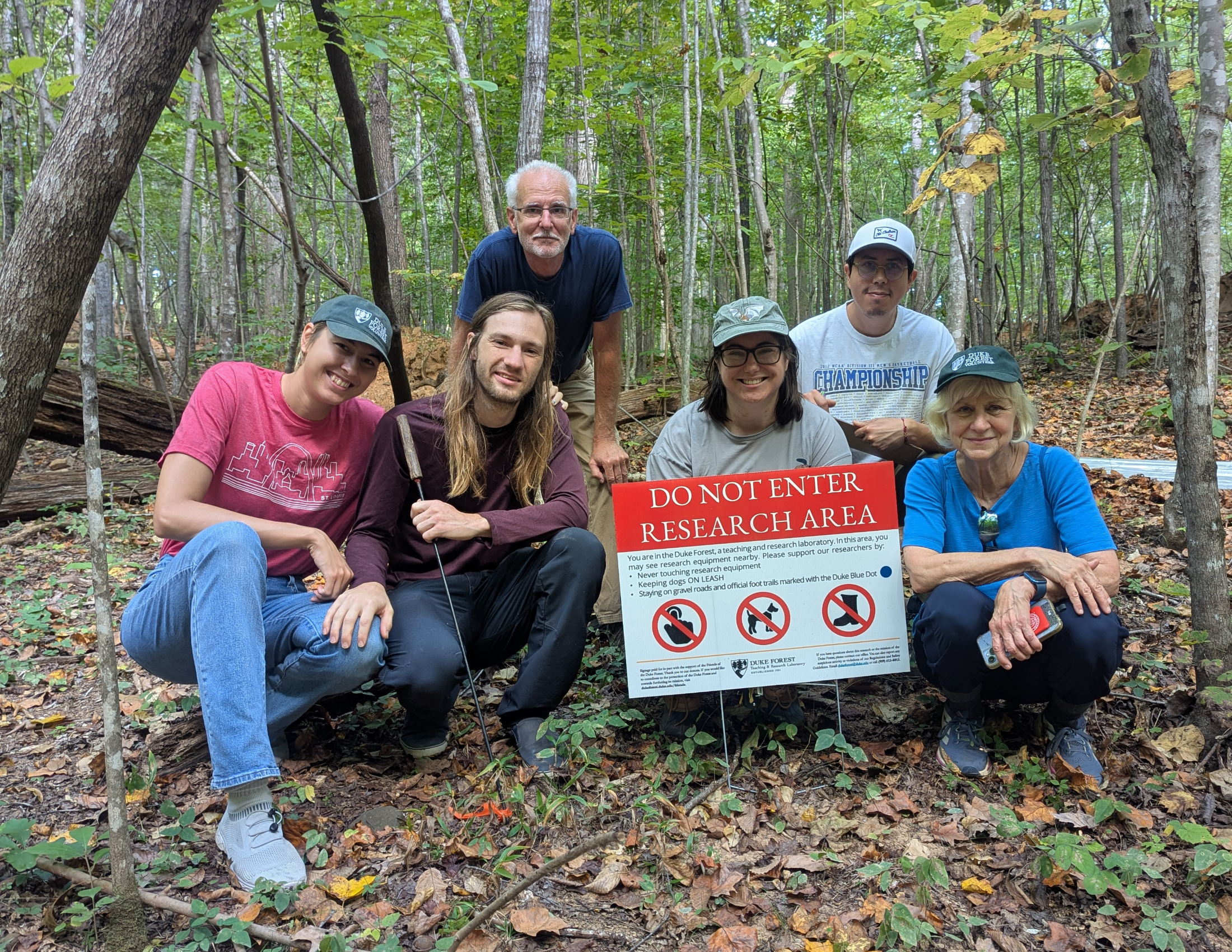
The Duke Forest is fortunate to have a growing community of passionate volunteers dedicated to supporting our mission, management, and strategy. In 2025, our volunteer community grew to include 57 Herpetofauna Community Scientists and 59 Forest Stewards. By the end of the year, they will have contributed over 1,700 hours of service. The generosity they show with their time, effort, and enthusiasm amplifies our stewardship efforts across the Duke Forest!
The Herpetofauna Community Science Program engages volunteers as scientists to monitor reptiles and amphibians—collectively known as herpetofauna—at specific sites in the Duke Forest. These community scientists collect and submit observational data, contributing to a growing dataset that informs our understanding of these important indicator species. For the first time this year, Herpetofauna Volunteers assisted our staff with Duke’s First-Year Orientation Programs, allowing us to engage nearly 300 incoming undergraduates with their work and other research, educational, and recreational opportunities the Forest offers.
The Forest Stewards Program invites volunteers who are eager to act as ambassadors. Stewards walk designated trail routes, reporting maintenance needs and providing a visible presence with their bright yellow vests. This year, we successfully grew our core of stewards and increased both the breadth of monitored Forest area and the number of engagements with recreational visitors. We also piloted a Forest Stewards Field Crew with a subset of stewards interested in assisting with trail maintenance. The Field Crew went out twice a month with Senior Program Coordinator Erin Hecht to respond to maintenance reports and were immensely helpful with cleanup after Tropical Storm Chantal.
We are so thankful for our Duke Forest volunteers!
Supporting Students and the Forest: The Ultimate Win-Win
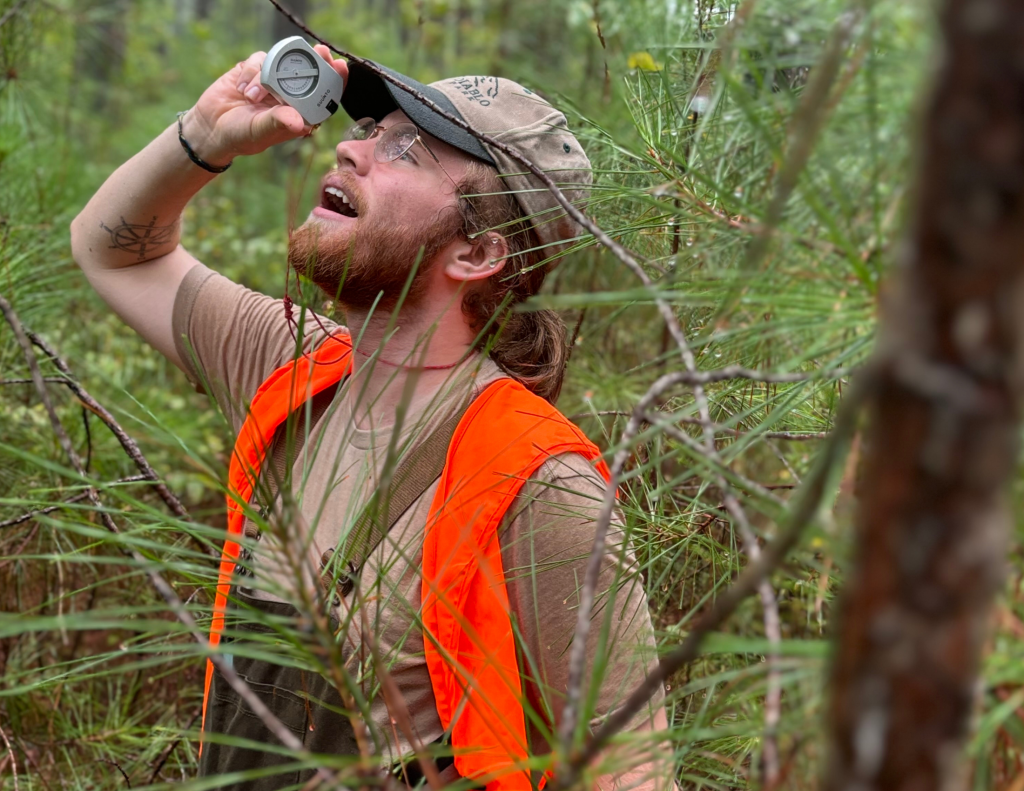
Eddie McDonald first met Duke Forest staff in Spring 2024 during a tour we hosted for accepted Nicholas School students at the Shepherd Nature Trail. Just a few months later, Eddie became the stand-out candidate for an assistantship with the Duke Forest as a first-year MEM-MF student. Since then, Eddie has become an invaluable member of our team.
Managing a teaching and research forest comes with a wide variety of responsibilities, and Eddie eagerly jumped in to help. His attention to detail proved essential for carefully updating our database of Duke Forest research publications and refreshing the content for some of our educational materials. In the field, Eddie was just as thorough and productive. He honed his sawyer skills clearing storm debris and conducting trail maintenance, and he quickly became a trusted field team member who worked equally well by himself or alongside other staff.
This year, Eddie continues his work with us as a Green Devil. Through this program, he serves as an intern with our team while also serving as an ambassador for the Office of Climate and Sustainability. We are grateful to have Eddie’s skill, dedication, and great attitude on the Duke Forest team!
Advancing Discovery Along New Hope Creek
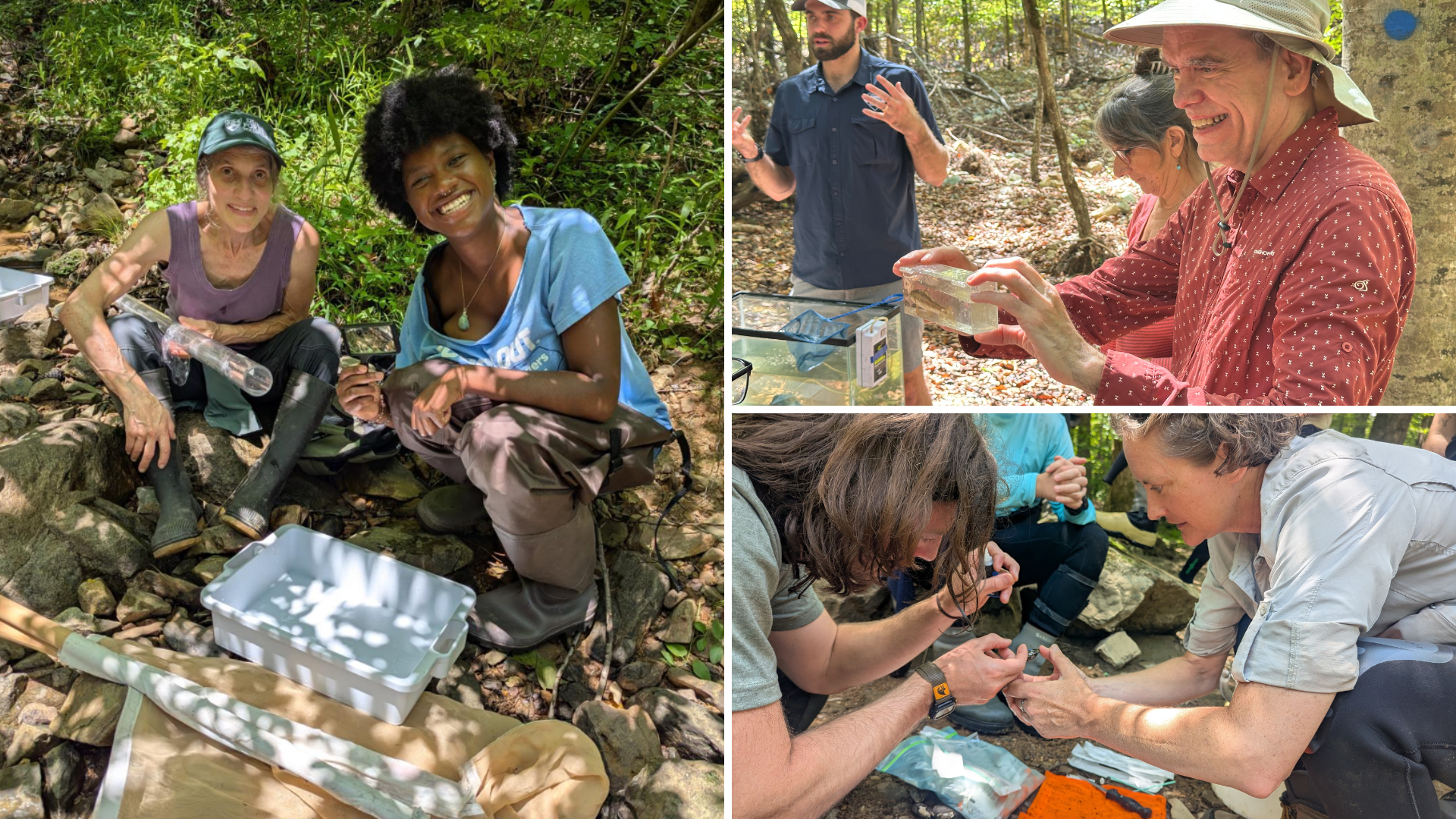
For more than three decades, Tim and Lori Rowe have lived near the Korstian Division of the Duke Forest, finding joy in countless hikes along its trails. Their deep connection to this landscape inspired them to create the New Hope Creek Teaching and Research Fund, a gift that strengthens learning and discovery connected to the Forest’s landmark New Hope Creek Restoration Projects.
Our team knows that restoring this vital ecosystem goes far beyond the completion of construction—it’s about ensuring that restoration efforts leave a lasting and measurable impact. The Rowes’ fund expands the scope of what is possible, supporting field studies for Duke students, drone-based topographical monitoring, surveys of threatened wildlife, and immersive educational programs.
“Duke Forest is a treasured educational and recreational resource for our community, and we’re grateful that it remains accessible to the public,” the Rowes shared. “We wholeheartedly support the vision behind the New Hope Creek Restoration Project and are thankful that these resources are being stewarded responsibly.”
Through their generosity, the Rowes are advancing environmental education and applied research that inform how the Forest is managed and protected. “We are thrilled to help with teaching and research in Duke Forest,” they said. “This will promote environmental education and increase everyone’s understanding of New Hope Creek, the Duke Forest, and the environment we all share.”
Looking ahead, the Rowes hope their gift will help ensure that the Duke Forest continues to be a place of learning, discovery, and inspiration for students, faculty, and the community for generations to come.
Thank you, Tim and Lori!
Learning in the Living Laboratory
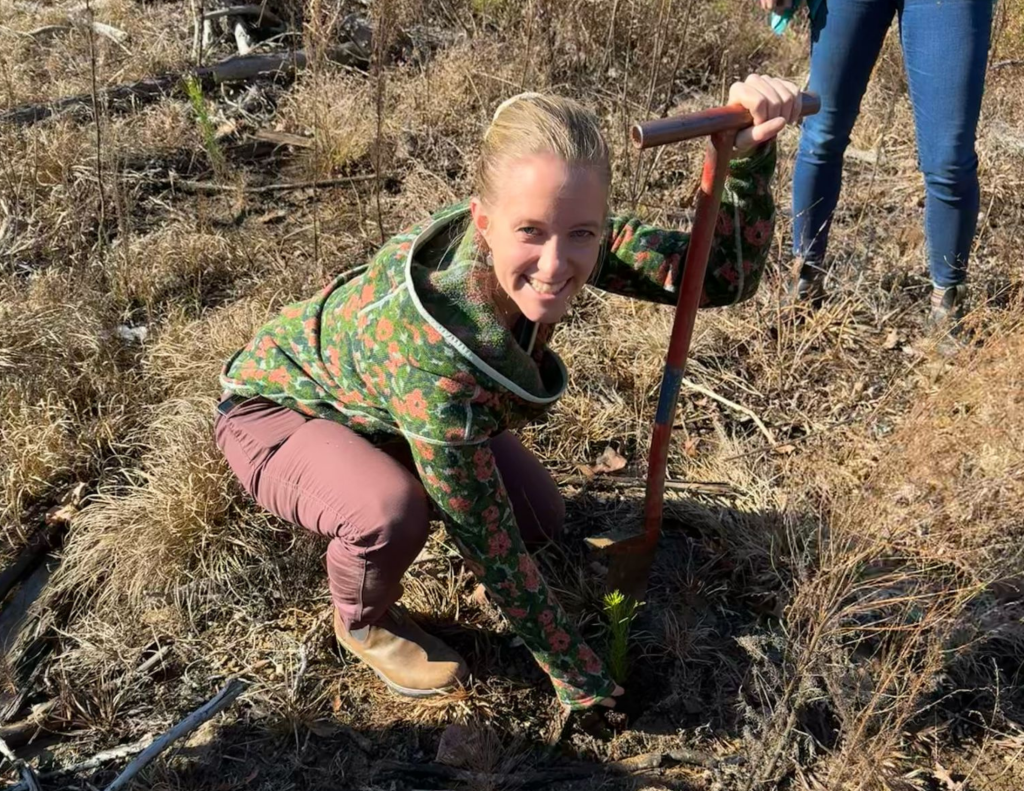
For students at Duke’s Nicholas School of the Environment, the Duke Forest serves as an outdoor classroom and a living laboratory, offering lessons that extend well beyond the lecture hall or textbook. For our Bruce and Ginny Roberts Management Intern, the experience is even more immersive, as the Forest becomes their workplace for the summer.
This summer, we welcomed our second Bruce and Ginny Roberts Intern, Alyssa Briggs, to the Duke Forest team. Alyssa is a talented and passionate Master of Forestry student who contributed to three major projects: a resample of the Continuous Forest Inventory (CFI) plots, site preparation for the New Hope Creek Restoration Projects, and cleanup of roads and trails after Tropical Storm Chantal.
“The CFI plots were a fabulous chance to gain proficiency at core field skills that are foundational to forestry work,” Alyssa reflected. She also expanded her learning by using a LI-COR Plant Canopy Analyzer to measure the amount of light available to the understory in different CFI plots. Although the summer weather did not provide ideal conditions for capturing data, the experience gave her valuable insight into the properties of light and the methods available to quantify it.
The Bruce and Ginny Roberts Internship Fund, established in 2023, is now the sole source of funding for internships in the Duke Forest. With continued support, this fund can provide more students like Alyssa with transformative opportunities to apply classroom knowledge in the field. If you are interested in securing or adding to this base of support, we invite you to contact our team.
Strengthening the Forest Through Duke’s Campaign
Following the University’s centennial year in 2024, Duke launched its Made For This campaign to advance bold ambitions in science and technology, climate, the student experience, and health. The Duke Forest is proud to contribute to these goals by focusing on priorities that will secure its role as a living laboratory, a model of resource stewardship, and a destination for discovery for generations to come. These priorities include:
- Securing long-term leadership for the Forest by endowing the Executive Directorship
- Expanding opportunities for teaching and research in climate and sustainability through dedicated seed funding
- Protecting ecosystems and promoting biodiversity through strengthened support for collaborative conservation efforts in the Triangle region
The Duke Forest thrives because of the community of people who believe in its value and potential. If you are interested in supporting these priorities, we invite you to reach out to our team to learn how you can be part of this important work. We’re Made For This!
Lean more about our campaign priorities at dukeforest.duke.edu/MadeForThis.