


In 2026, the Office of the Duke Forest is leading our eighth year of the herpetofauna (or “herp”) community science program. This program engages volunteer scientists to monitor amphibians and reptiles—collectively known as herpetofauna—at specific sites in the Duke Forest. Herpetofauna are increasingly important today as their populations are key indicators of the effects of climate change and habitat fragmentation on wildlife.
This program is also valuable for volunteers, allowing them to participate in scientific field research, learn about Duke Forest fauna, and work alongside like-minded nature lovers. We encourage volunteers of all backgrounds and experience levels to apply to participate (you don’t have to be a herp expert!). Applications are now open for the 2026 season will close on Sunday, January 25th. The application link can be found below the program information and schedule sections.
PURPOSE & IMPACT: Community scientists help the Duke Forest to collect wildlife data on a scale that we could never do alone. Over time, we can learn more about the herpetofauna that currently exist here and how to better manage the Forest so that they thrive. This program is part of a larger effort underway at the Duke Forest to better protect and promote the wildlife species that call it home. Additionally, Duke faculty and students directly incorporate these data into research and class projects, and wildlife biologists and conservation partners can use them to map animal distributions and wildlife connectivity.
Our program is advised by Dr. Nicolette Cagle, Nicholas School of the Environment professor.
TIME COMMITMENT:
- We are seeking dedicated community scientists who will commit to the entirety of the program from late February through October 2026.
- Volunteers are grouped into teams of about six-seven people. Every week, teams are responsible for designating at least two teammates to complete a monitoring visit. A monitoring visit consists of both field data collection at a transect in the Duke Forest and computer-based data entry at home.
- Teammates share the work (volunteers may be able to take an occasional “off week”), but each community scientist is responsible for participating in team communications to coordinate weekly activity.
- On average, the total commitment per week is ~1-2 hours (excluding travel time to the Forest).
ACCESSIBILITY:
Walking in a forested environment involves obstacles, uneven surfaces, significant slopes, and moderate distances. Mobility consistent with that demonstrated in the video on the right is required for participation in this program. For those with less mobility, there may still be other ways to contribute to this project, and we welcome you to email dukeforest@duke.edu to inquire about these opportunities.
2026 Season Schedule
| January 7 | Volunteer applications open. |
| January 25 | Volunteer applications due by end of day. |
| 1st week of February | Applicants are notified of acceptance. |
| Mon, Feb 16 from 7-9pm | Mandatory* virtual training on Zoom. *If you are new or have not participated in the Herp Program within the past year (January 2025 onward), you are required to attend the virtual training. For returning volunteers who did participate in 2025, this training is optional. |
| Sat, Feb 21 from 9am-12pm STORM DATE: Sun, Feb 22 from 9am-12pm | Mandatory in-person training at the Duke Forest Maintenance Shop. All participants (even returning volunteers) are required to attend the in-person training, in order to satisfy data collection procedures and Institutional Animal Care and Use Committee protocols. 9-10:30am is required for all 2026 volunteers, 10:30am-12pm is required for new volunteers and is optional for returning volunteers. This training will primarily be held inside and will only be rescheduled to the Sunday storm date in the event of icy road conditions. |
| Feb 25-June 28 | Transect visits take place Wednesday to Sunday of each week. |
| June 29-July 7 | No transect visits conducted. Holiday break for July 4th week! |
| July 8-Sept 20 | Transect visits take place Wednesday to Sunday of each week. |
| Sept 21-Oct 25 | Transect Visits take place on Saturdays and Sundays ONLY. Duke Forest’s annual Deer Herd Reduction Program begins on Monday, September 21st, 2026, and the Forest will be closed on weekdays for deer hunting. |
| Sun, Oct 25 | End of 2026 Herp Program |


Please fill out the application linked below to indicate your interest in participating in the 2026 Herpetofauna Community Science Program. This is an application and does not guarantee acceptance into the program. Please also note the following requirements:
- Participants must commit to the entirety of the 2026 season, from late February through October.
- Must complete all trainings led by Duke Forest staff—including virtual and in-person trainings (details in the program schedule above).
- Must be 18 years of age or older. (Minors 16 years of age or older may be able to participate with a parent/guardian but must reach out to dukeforest@duke.edu for advanced consideration.)
- Must be able to spend an average of 1-2 hours per week in the field and at home submitting data (your team will share some of the work).
- Will not be asked and are not allowed to directly handle the animals.
- Must be willing to work in a team and communicate clearly to schedule visits, collect data, and enter data.
- All interested individuals must apply. If you have a friend or partner who would like to participate, please encourage them to fill out their own application.
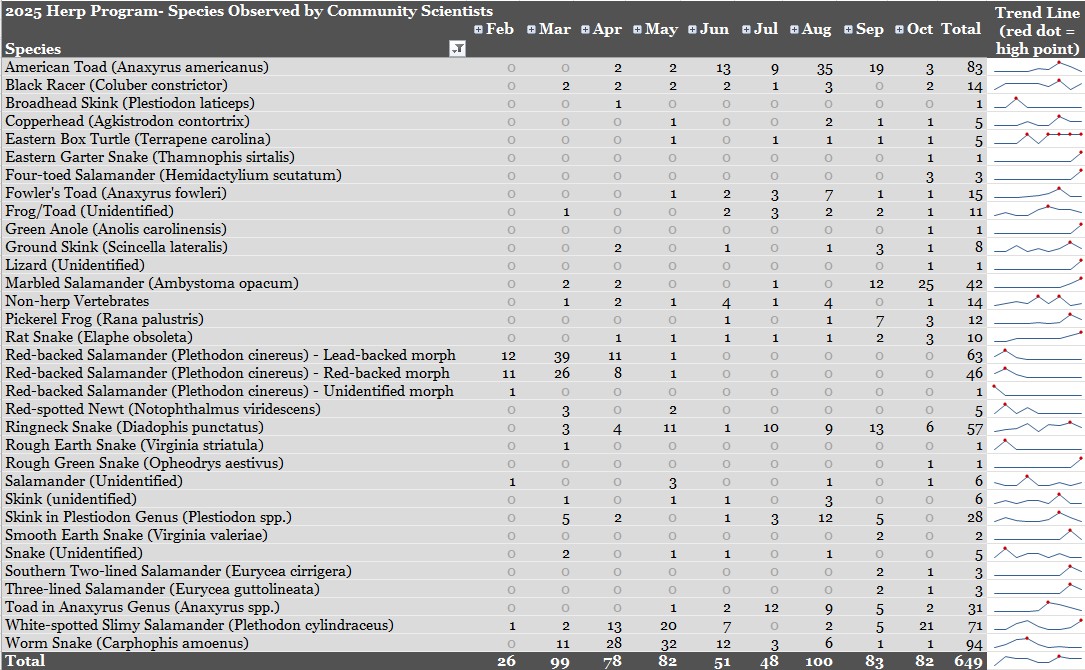
2025 Herpetofauna Observed