



Quick Links: Alerts and Closures | Closure Map | About the Projects | Frequently Asked Questions
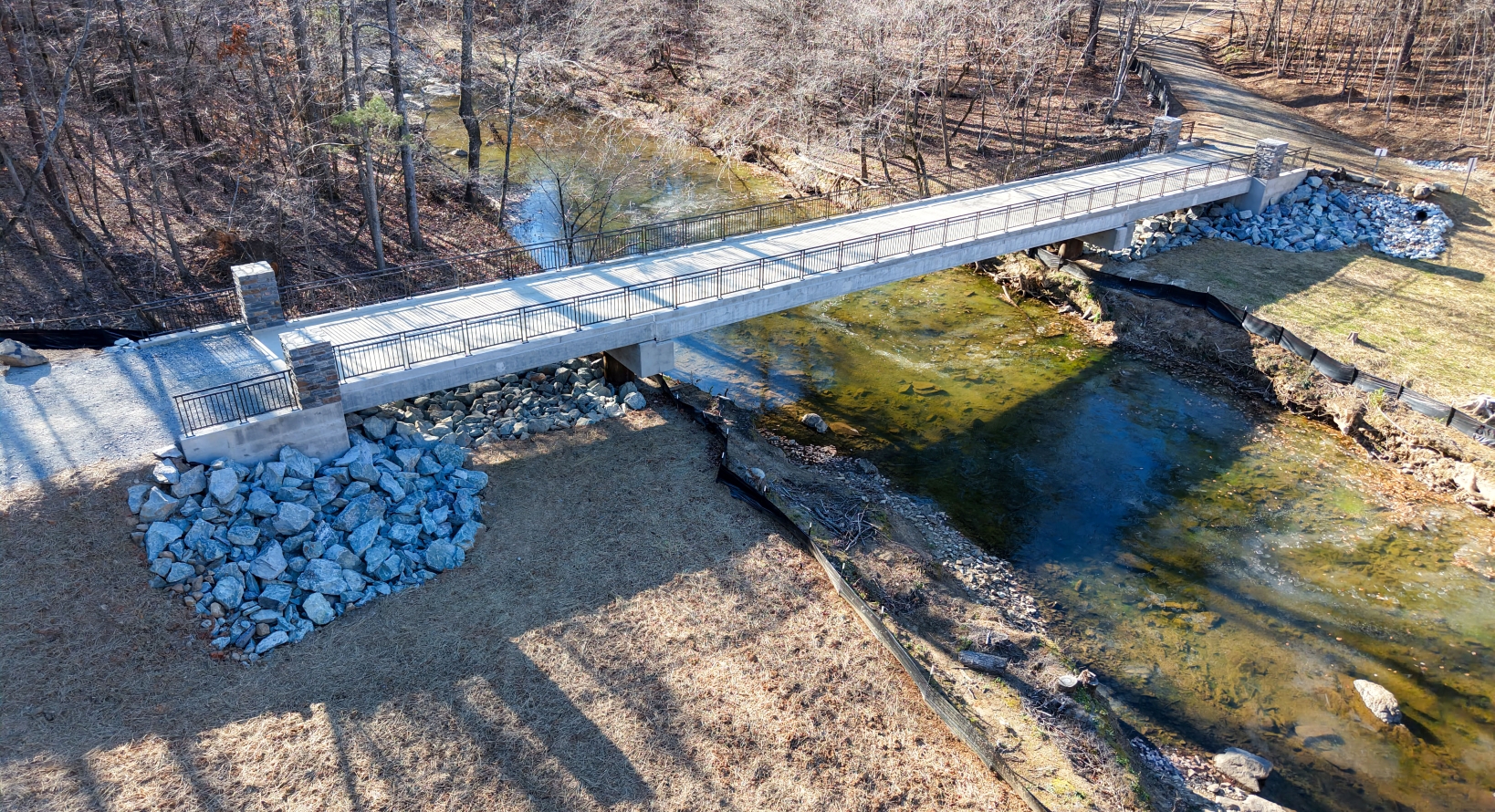
All three phases of the New Hope Creek Restoration Projects are now complete! Recreational visitors may resume daily access along authorized forest roads and foot trails near New Hope Creek during daylight hours.
We are grateful to our recreational visitors for your interest, understanding, and support, particularly those who chose to recreate elsewhere during the closure. Thank you for helping us care for the Forest!
Our team is still rehabilitating the construction zone around the new clear-span bridge over New Hope Creek. As always, recreational visitors are asked to defer to all posted signage and to avoid disturbing newly seeded erosion control areas.
To learn more about how the projects progressed, including timelapse construction footage of the new bridge, please visit our Instagram or Facebook and look for our “This Week at New Hope Creek” posts.
About the NHC Restoration Projects:
The Duke Forest Teaching and Research Laboratory is Duke University’s 7,100-acre teaching and research forest. The Office of the Duke Forest manages this resource to meet multiple objectives, including the conservation and stewardship of natural resources. The goal of Duke Forest’s NHC Restoration Projects is to improve aquatic habitat, restore aquatic habitat connectivity, stabilize stream banks, and promote and protect freshwater mussel populations through the removal of two in-stream, human-made structures. These projects address long-standing infrastructure issues that negatively impact the health and function of NHC.
Project Site #1: Concrete Bridge
At the heart of the project is the replacement of the Concrete Bridge (CB), a low-water crossing constructed in the 1930s by the Civilian Conservation Corps. Originally outfitted with four metal culverts, two are now permanently clogged and the others frequently obstructed, causing the structure to act as a dam during low flows. The CB disrupts the natural movement of aquatic organisms, degrades and fragments aquatic habitat, and artificially impacts water flow and quality. Also, it is the only structure that provides official passage across the creek for forest management vehicles, emergency vehicles, and recreational visitors, but it fails to consistently provide this function depending on flow conditions.
Removal and replacement of the CB will restore more natural flow conditions, improve aquatic habitat and passage for native aquatic organisms including fish and mussels, prevent further degradation of the streambed, and mitigate erosion of the stream banks. The replacement bridge will avoid placing any structures within the stream habitat, and as it will be elevated over average stream height, it will consistently provide safe, dry passage during all typical flow conditions through all seasons.
Project Site #2: Billy Erwin Dam
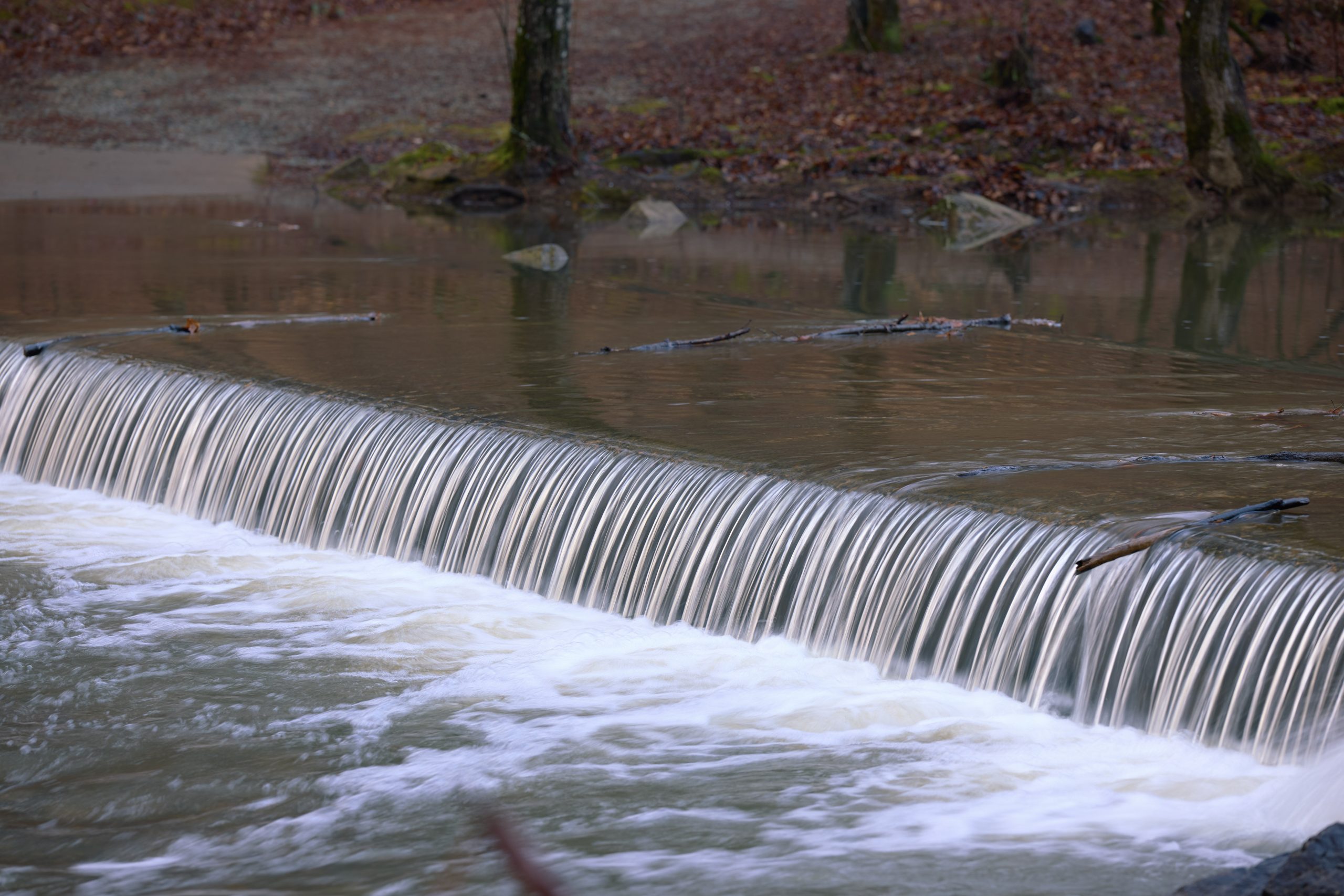
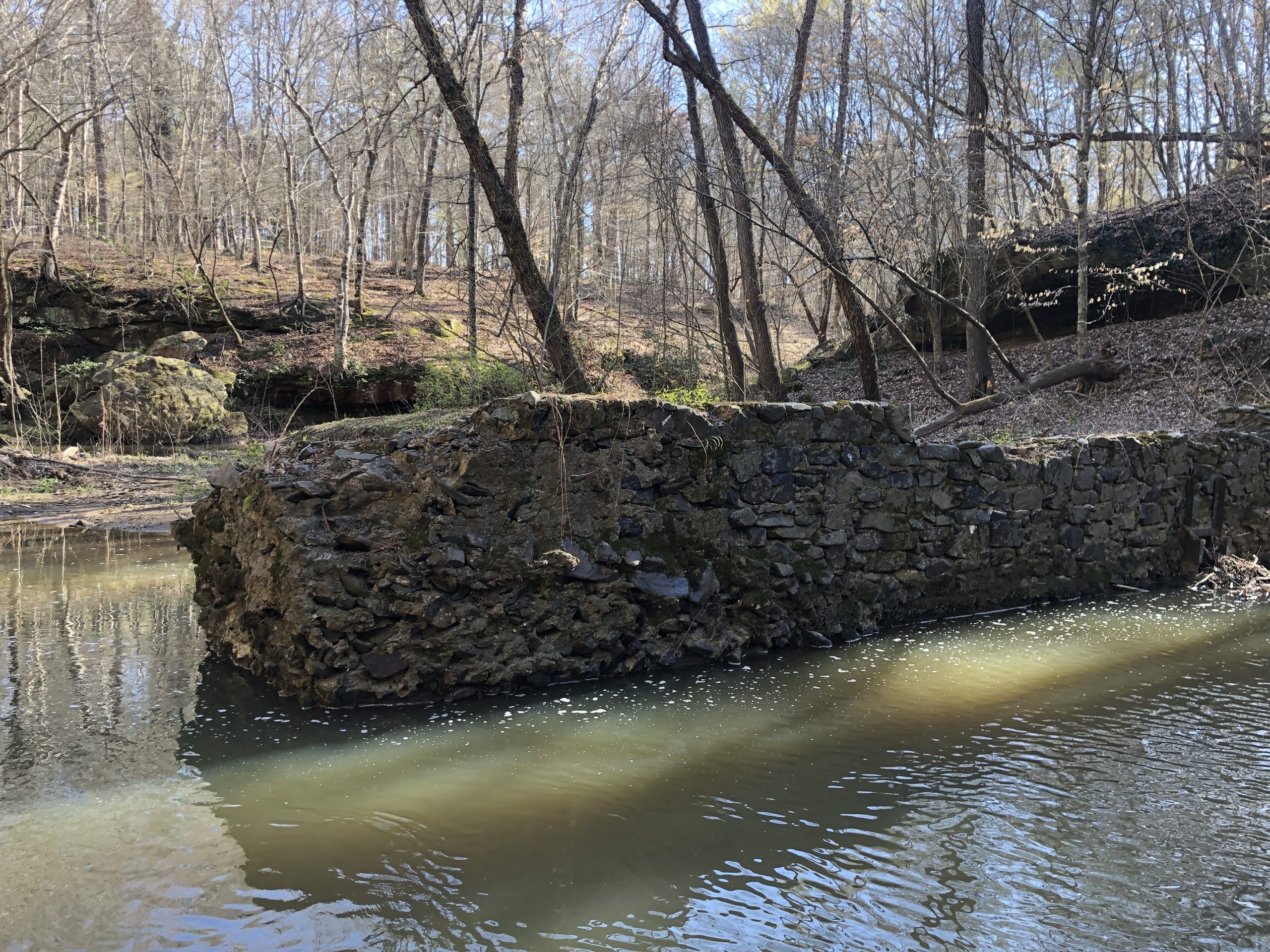
Roughly a mile downstream, the partially breached Billy Erwin Dam, built in the early 1900s for a hydropower project that was never completed, continues to alter the natural flow of NHC. Water now bypasses the structure on one side, rapidly eroding the adjacent streambank and threatening nearby hiking trails. This erosion also leads to significant sedimentation downstream, where a mid-channel island has formed, further impairing aquatic habitat and stream function. Removal of this structure will restore more natural flow conditions, reduce erosion along the north bank, and allow for stabilization of the nearby hiking trails.
Project Details and Timeline
- Stage 1: Construction of a new, clear-span bridge approximately 150 feet upstream from the Concrete Bridge. The new bridge will be carefully positioned where the natural topography allows it to integrate seamlessly into the existing fire road network. Designed to withstand high-flow events, including those predicted in 100-year storm scenarios. Completed: Late fall 2025
- Stage 2: Deconstruction and removal of the Concrete Bridge to allow the creek to move unimpeded, restoring its dynamic equilibrium. Completed: Fall 2025
- Stage 3: Demolition of the defunct Billy Erwin Dam. Material from the dam will be left in-situ to shore up the stream banks. Completed: Late summer 2025

Our Partners
Funding for the projects was secured through partnerships and generous private donations. Working with our friends at Triangle Land Conservancy, we secured a grant from the North Carolina Land and Water Fund. A leadership-level gift from Brad and Shelli Stanback, along with significant donations from Alston Gardner and Adam and Rosalind Abram, helped us reach the $2 million threshold to begin the projects. Additional support from Tim and Lori Rowe was earmarked to create the NHC Teaching and Research Fund to leverage this pivotal moment in the Forest’s history in service to its mission as teaching and research laboratory (details below).
Teaching and Research Opportunities
These projects readily achieve the first goal of the Duke Forest Strategic Plan, which is to steward the natural, financial, and human resources of the Duke Forest for long-term success and sustainability as a major University asset for research, teaching, and community engagement. They also uniquely exemplify Duke’s Climate Commitment through achieving the essential work of stewarding our natural environment through the implementation of sustainable solutions across Duke’s infrastructure and operations.
Restoring this vital ecosystem is about more than just completing the construction projects; it’s about ensuring that the restoration efforts have a lasting and measurable impact. Our team is dedicated to thorough environmental assessment and research to fully understand the ecological benefits of these projects and to provide students with hands-on field experience, empowering the next generation of environmental leaders with the tools to transform knowledge into action.
We plan to:
- Capture high-resolution LiDAR data through seasonal drone flights to track the evolution of the creek’s geomorphology and floodplain changes over time.
- Monitor New Hope Creek for macroinvertebrates because their presence, diversity, and abundance are key indicators of water quality and overall stream health.
- Support Duke courses by providing students with hands-on learning opportunities using water testing kits and fieldwork.
- Sustain our partnership with the North Carolina Wildlife Resources Commission, enabling us to monitor critical habitat for the federally threatened Atlantic Pigtoe mussel.
- Fund exploratory research opportunities with Duke graduate students, allowing for innovation without the constraint of securing outside funding.


Public education and engagement opportunities will be advertised on our website and in our monthly email newsletter.
Frequently Asked Questions
Click each question to read the answer.
The goal is to restore hydraulic and ecological function to the creek that has been and continue to be negatively impacted by human-made structures within it. The removal of these old structures will restore natural flow conditions, habitat connectivity, and movement of organisms within the creek. The replacement bridge is designed to provide safe, reliable passage of people and vehicles across the creek, for at least another generation with minimal impact to the creek itself. This work directly supports the long-term health of the ecosystem and its resilience, especially in the face of climate change, and it offers unique opportunities for research, education, and recreation.
The new clear-span bridge will replace the Concrete Bridge and allow water to flow freely beneath it, even during significant rainfall. This will reduce erosion and flooding risks while improving conditions for aquatic species, such as the Atlantic Pigtoe mussel (Fusconaia masoni) and its host fish, the Creek Chub (Semotilus atromaculatus).
Yes, some areas near the project site will be temporarily closed 7 days/week (Monday through Sunday) to ensure safety and allow work to proceed efficiently. Signage with closure maps will be posted in impacted areas and updates will be posted on this webpage.
Construction of the new clear-span bridge is expected to be completed this summer, with demolition of the Concrete Bridge and Billy Erwin Dam estimated to wrap up by early fall.
While specific timelines may shift, we will keep the community informed of major milestones and progress through this webpage and our monthly email newsletter.
The restoration supports Duke’s Climate Commitment by enhancing local biodiversity, improving ecosystem resilience, and creating expanded opportunities for climate-related research and education in the Duke Forest.
The restoration projects are designed to improve habitat quality for a wide range of wildlife by restoring natural stream function and reducing erosion. Over time, these improvements will support greater biodiversity and provide healthier, more connected ecosystems.
To minimize short-term impacts on critical wildlife during construction, we are working with the North Carolina Wildlife Resources Commission to relocate all freshwater mussels within the project area to high quality habitat upstream. Because most of the project’s impact is limited to the creek, we do not anticipate significant effects on terrestrial wildlife.
There are several facilitative projects that our team needs to complete before, during, and after the restoration in order to facilitate construction and mitigate construction impacts. In addition, the forest roads and trail systems near the Concrete Bridge will be minimally reconfigured to adjust to the new bridge’s location.
Our team has collaborated with the construction team to minimize tree removal and alterations to existing infrastructure, such as forest roads and culverts. Most modifications to the Forest will occur along Concrete Bridge Road inside Gate 25. A small area of young Loblolly Pine trees will be cleared to create a staging area for construction equipment; the selected location actually takes advantage of a small area previously cleared for logging. Trees along the road to the project site will be limbed to provide a 30-foot clearance for all construction equipment and bridge materials to be brought to the project site, including a crane. At one tight turn in the road, a small section of small diameter hardwood trees will be removed to allow the maneuvering of 70-ft concrete slabs down to the project site. A small area of vegetation will also be cleared between the existing bridge and the new bridge to facilitate construction and materials staging.
These projects are designed with long-term resilience in mind. The new clear-span bridge has an expected lifespan of around 100 years and is engineered to withstand increasing climate pressures, including major flooding events. In addition, as part of our partnership with the Triangle Land Conservancy, 152 acres along New Hope Creek and Piney Mountain Creek will be permanently protected under a conservation easement, safeguarding this critical watershed from future development and ensuring the benefits of restoration endure for generations.
Status Update Archive
The last major milestone in the New Hope Creek Restoration Projects has been achieved! The historic Concrete Bridge, constructed in the 1930s by the Civilian Conservation Corps, has now been fully removed. With both the Concrete Bridge and the Billy Erwin Dam gone, New Hope Creek flows freely through the Duke Forest for the first time in a century—the ultimate goal of the restoration.
Reminder: The Restoration Closure Area remains closed 7 days per week. This closure ensures the safety of visitors and gives our team the time and space needed to rebuild trail connections, stabilize streambanks, and complete other essential restoration steps. We know how eager the community is to return to this part of the Forest, and we appreciate your continued compliance as we work toward reopening in December.
Earlier this month, the Billy Erwin Dam came down in just two days. All of the demolished materials were carefully redistributed to reinforce eroded streambanks, helping stabilize the area and prevent future damage. This marks the first of two human-made structures to be removed as part of this restoration effort.
Meanwhile, at Project Site #1, work on the new clear-span bridge is moving full steam ahead. Ten 30-foot concrete slabs have been installed to connect the central five 70-foot spans to the end bents on either side of the creek. Now, the crew is pouring the concrete deck that will soon become the bridge surface. Once the deck cures, the new clear-span bridge will be able to support vehicles and equipment crossing the creek, paving the way (literally!) for the next stage: the demolition and removal of the old Concrete Bridge.
Two and a half months into the New Hope Creek Restoration Project, the new clear-span bridge is taking shape! After successfully drilling and pouring concrete support pillars and other foundational structures, our partners from Sanford Contractors have now installed the central part of the bridge deck, consisting of five 70-foot concrete slabs.
Our team, along with project managers from our contractors and partners, was on-site to witness the delivery and installation of the concrete slabs. See for yourself the careful choreography of the installation, as well as pictures and time-lapse videos of the progress so far at Restoration Project Site #1!
The bridge’s foundation and structure are beginning to take shape. With drilling for the support pillars completed last week, the construction crew has moved on to forming the tops of the two bents (the structures that will hold the bridge deck and transfer its weight into the foundation).
Although recent rains and flooding from last month’s Tropical Storm Chantal have delayed the schedule by about a week, steady progress continues on this exciting project!
Tree clearing from the construction zone is complete. Throughout July (aside from the brief pause after Tropical Storm Chantal), our field team and local logging partner worked hard to fell and remove trees from the construction zone.
With most of our prep work complete, the site is now ready for our contractor to bring in vehicles and equipment to begin building the new clear-span bridge (Phase #1 of these projects).
Read more about how our team spent part of this month assessing and repairing storm-related damage across the Duke Forest.
Our team has rebuilt the double culvert and forest road inside Gate 25 that was washed out during Tropical Storm Chantal, restoring access for construction vehicles to the restoration site. We expect our contractors to reinstall erosion control measures this week, which will allow us to remove the remaining few trees from the construction area before final preparations for bridge construction begin.
Read more about how our team spent last week assessing and repairing storm-related damage across the Duke Forest.
During the first week of work on the restoration projects, our team installed closure signage along foot trails and forest roads within the restricted area. With the help of a local logging partner, we also cleared a small section of trees on both sides of New Hope Creek to prepare for the installation of the new bridge and its connection to Concrete Bridge Road.
Unfortunately, progress this week will be slowed due to flooding, debris, and damage caused by Tropical Storm Chantal. We will focus on removing storm debris, replacing damaged erosion control fencing, and rebuilding a section of forest road inside Gate 25 that was washed out by floodwaters.
Effective today, June 30, until further notice, a portion of the Korstian Division is closed to recreation in order to facilitate the New Hope Creek Restoration Projects. (Closure Map) These closures will remain in effect seven days a week for the duration of work at Project Site #1 and will likely overlap with closures in the fall to support the Deer Herd Reduction Program.
“ATTENTION” signs at all Korstian gates have been updated to show the active closure, and “CLOSED” signs have been posted on all affected roads and trails.
We appreciate your patience and cooperation during this important restoration effort. These projects are critical to the long-term health of New Hope Creek and to the research, teaching, and engagement missions of the Duke Forest.
With all necessary permits obtained and regulatory approvals secured, we have officially awarded the contract for the restoration projects! The contractor will begin work on Monday, June 30, which will start final preparations before beginning Phase 1 of the projects (new bridge construction) later that week.
The partial closure of the Korstian Division will start on Monday, June 30. These closures will remain in effect seven days a week for the duration of work at Project Site #1 and will likely overlap with closures in the fall to support the Deer Herd Reduction Program.
“ATTENTION” signs at all Korstian gates will be updated to show the active closure, and “CLOSED” signs will be posted on all affected roads and trails.
We appreciate your patience and cooperation during this important restoration effort. These projects are critical to the long-term health of New Hope Creek and to the research, teaching, and engagement missions of the Duke Forest.
Duke Forest staff have completed several facilitative projects on-the-ground, but the contractor “move-in” date remains in flux as we navigate the typical processes around contracts, permitting, and of course, the weather! Right now, we anticipate the partial closure of the Korstian Division to begin on or around Monday, June 30th.
The partial closure of the Korstian Division, originally scheduled to begin this Sunday (June 15), has been postponed. Recreational visitors now have some additional time to enjoy the area around the Concrete Bridge while final preparations for the New Hope Creek Restoration Projects are completed.
While we await final permits and assessments, our team has been diligently executing several facilitative projects, as well as pre-restoration LiDAR drone flights and relocating mussels upstream from the future construction area. More information and photos from these activities will be shared in our monthly e-LOG newsletter next week.
After receiving three bids for the NHC Restoration Projects, we are preparing to award the contract. If all goes well, the overall sequence/expected timeline is set to begin in late June and will proceed as follows: new bridge construction (summer), old bridge removal (late summer), and old Billy Erwin dam removal (early fall). As you might imagine, the Duke Forest team has shifted into high gear to prepare for the project on-the-ground.